Tools for the Symbiocene
Resources on green hope & ecopedagogies
"[Hope] is an axe you break down doors with in an emergency; because hope should shove you out the door, because it will take everything you have to steer the future away from endless war, from the annihilation of the earth’s treasures and the grinding down of poor and marginal. Hope just means another world might be possible, not promised” - Rebecca Solnit, Hope in the dark: Untold histories, wild possibilities
Intersectional forms of resistance are vital for building more sustainable and climate-just worlds. But, we must also have some inkling of where we wish to go, what kinds of worlds we wish to enact and sustain. Critique and imagination are two equally important engines of transformative socio-ecological change.
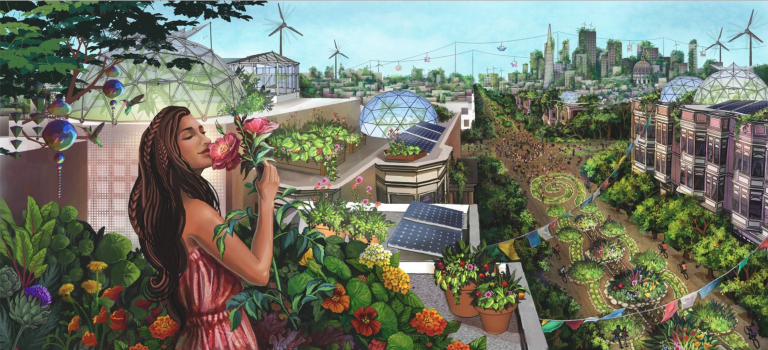
Thus, we've compiled this list of materials and resources designed to nurture green hope and foster our imaginative capacities for building radical alternatives within and beyond capitalism. This list is necessarily a work in progress, so please reach out with suggestions from your own practice so that we can continue expanding it! Let's work together towards what philosopher Glenn Albrecht terms the 'Symbiocene' - a desirable, more liveable future of respectful conviviality with Earth others.
Pedagogical tools for (re)imagining sustainable worlds
- Solarpunk Futures game
- ‘Breaking free from mining- a 2050 blueprint’ – Seas at Risk
- ‘Imagining a world without mining’ workshop activity (pp. 71 – 74)
- Fashion Fictions
- ‘Activity: Designing cities of the future’ – Natural History Museum
- ‘Council of all Beings’
- Global Tapestry of Alternatives
Allied initiatives
- Common Ecologies - A movement school and a platform for movement learning, alliance-building and co-research for socio-ecological justice
- EJ Atlas - database tracking ecological distribution conflicts around the globe actively creating new worlds and ecological possibilities
- People & Planet 'fossil free universities' campaign
- Plant-based Universities campaign
Resources on ecopedagogies & (green) hope
- ‘Imagine 2200’ climate fiction series – Grist
- ‘Demand utopia: A Solarpunk podcast’
- Ajaps, S. (2023). Deconstructing the constraints of justice-based environmental sustainability in higher education. Teaching in Higher Education, 28(5), pp.1024-1038.
- Alberro, H. (2024). Terrestrial ecotopias: Multispecies flourishing in and beyond the Capitalocene. Peter Lang.
- Alberro, H., Van dermijnsbrugge, E., Firth, R. and Kopnina, H. (2026). ‘Educating to transgress’: ecotopian pedagogies for the Symbiocene. Pedagogy, Culture & Society, pp.1-19.
- Barnett, R. (2017). The ecological university: A feasible utopia. Routledge.
- Burns, H.L. (2015). Transformative sustainability pedagogy: Learning from ecological systems and indigenous wisdom. Journal of Transformative Education, 13(3), pp.259-276.
- Ingold, T. (2024). How to imagine a sustainable world. Acta Borealia, 41(1), pp.7-15.
- Irene, J. O., Irene, B. N., Omeihe, K. O., Frank, R. (2025). The emerald handbook of decolonising sustainability: A Global South perspective. Leeds: Emerald Publishing Limited.
- Kahn, R.V. (2010). Critical pedagogy, ecoliteracy, & planetary crisis: The ecopedagogy movement (Vol. 359). Peter Lang.
- Kimmerer, R.W. (2013).Braiding sweetgrass: Indigenous wisdom, scientific knowledge and the teachings of plants. Milkweed editions.
- Lotz-Sisitka, H., Wals, A.E., Kronlid, D. and McGarry, D. (2015). Transformative, transgressive social learning: Rethinking higher education pedagogy in times of systemic global dysfunction. Current opinion in environmental sustainability, 16, pp.73-80.
- Mazzocchi, F. (2020). A deeper meaning of sustainability: Insights from indigenous knowledge. The Anthropocene Review, 7(1), pp.77-93.
- McGeown, C. and Barry, J., 2023. Agents of (un) sustainability: democratising universities for the planetary crisis. Frontiers in sustainability, 4, pp. 1 – 14.
- Misiaszek, G.W. ed. (2025). Ecopedagogy and the Global Environmental Citizen: Critical Issues, Trends, Challenges and Possibilities. Taylor & Francis.
- Solnit, R. (2016). Hope in the dark: Untold histories, wild possibilities. Haymarket Books.
- Solnit, R. and Young-Lutunatabua, T. eds. (2023). Not too late: Changing the climate story from despair to possibility. Haymarket Books.
- Stephens, J.C. (2024). Climate justice and the university: Shaping a hopeful future for all. JHU Press.
- Taylor, A., Zakharova, T. and Cullen, M. (2021). Common worlding pedagogies: Opening up to learning with worlds. Journal of Childhood Studies, 46(4), pp.74-88.
- Thaler, M. (2022). No other planet: Utopian visions for a climate-changed world. Cambridge University Press.
- Walsh, Z., Böhme, J., Lavelle, B.D. and Wamsler, C. (2020). Transformative education: towards a relational, justice-oriented approach to sustainability. International journal of sustainability in higher education, 21(7), pp.1587-1606.
Resources on critical/utopian pedagogies
- Bell, D. (2022). Occupy the classroom radically. Third World Quarterly, 43(8), pp.2063-2074.
- Coté, M., Day, R. and De Peuter, G. (2007). Utopian pedagogy: Creating radical alternatives in the neoliberal age. The Review of Education, Pedagogy, and Cultural Studies, 29(4), pp.317-336.
- Freire, P. (2021). Pedagogy of hope: Reliving pedagogy of the oppressed. Bloomsbury Publishing.
- Giroux, H.A. (2010). Rethinking education as the practice of freedom: Paulo Freire and the promise of critical pedagogy. Policy futures in education, 8(6), pp.715-721.
- hooks, b. (2014). Teaching to transgress. Routledge.