
The student-led campaign to get Trinity College Dublin to endorse the Fossil Fuel Non-Proliferation Treaty
On 11th February 2026, Trinity College Dublin announced that it had formally endorsed the Fossil Fuel Non-Proliferation Treaty, following approval by its Environment and Sustainability Principal Committee of Board.
Trinity's endorsement of the Treaty was the result of a campaign by a group of four student members of the CJUU, supported by their lecturer, Trinity Branch CJUU member and Secretary, Martin Sokol (Geography).
The Fossil Fuel Non-Proliferation Treaty initiative is an international alliance of nations, subnational governments, and civil society who are working to pursuade governments to sign up to a legal instrument that would secure a global just transition from coal, oil and gas. It seeks to address the failure of the COP process to address continued growth in fossil fuel use as a primary impediment to reducing CO2 emissions and keeping global warming below the Paris Agreement target of 1.5C.
The Treaty has been endorsed by individuals, civil society organisations, faith groups, cities, and subnational governments all over the world - but only a handful of national governments. Many of the nations who have endorsed the treaty are those that are most immediately threatened by the climate crisis, like Vanuatu amd Tuvalu. Endorsement of the treaty by universities sends a clear signal to governments, business, and industry that the academic research and scientific evidence demands an end to the expansion of coal, oil and gas production. It creates upward pressure for governments to participate in discussions on pathways to a just transition and fair phase-out of fossil fuels.
Recognising the importance of such a signal from universities, the students devised a campaign aimed at measuring support for endorsing the treaty amongst Trinity students and staff, and lobbying Trinity's Sustainability Office and Vice-Provost for Biodiveristy and Climate Action to endorse the treaty.

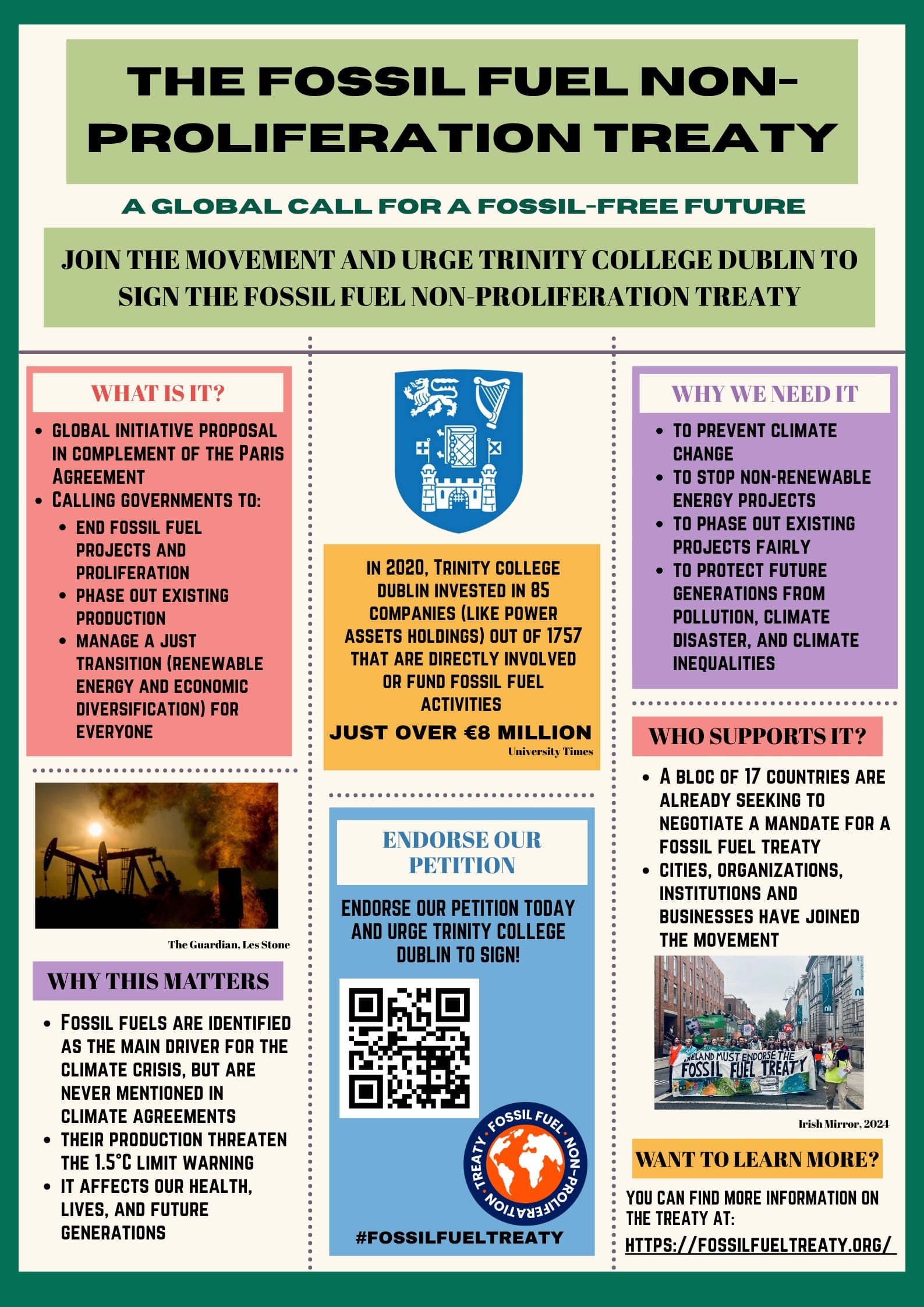
The students created a petition on change.org, which was shared amongst other CJUU Trinity Branch members, and was advertised around the university using a poster they created.
The students also held meetings with members of the Sustainability Office, who recognised that endorsing the treaty would be in line with the university's Sustainability Strategy, as well as other key policies in the university. Ultimately, it was agreed that endorsing the treaty would be brought to the Environment and Sustainability Principal Committee of Board, who approved.
This case study illustrates several ways in which members of the university community can get involved in action for climate justice.
One - a lecturer created a for-credit assignment that enabled students to engage in real-world climate action. The students working together as a team on this project earned 50% of the marks for a 5 ECTS module through their action research and accompanying report.
Two - students identified a SMART (Specific, Measurable, Achieveable, Realistic, Time-Specific) target for their climate action project, figured out who in the university they needed to convince, and then developed a campaign to achieve their goal.
Three - the student team joined the Trinity Branch of the Climate Justice Universities Union and took advantage of its network and communications to spread the news of their campaign. Other members of the Union signed the petition and voiced their support for Trinity's endorsement of the Treaty, creating support and upward pressure.
We hope this example of student-led action for meaningful change can inspire other CJUU members to lead similar campaigns!